
Google Search AI Mode: What B2B Organizations Need to Do Now to Stay Visible
Remember Ask Jeeves? Back then it seemed natural to ask a search engine a question in a fully formed sentence, the way you would another person. Over time, Google taught us to think in search terms and keywords.
But now, thanks to AI, we’re headed back to 1999.
The days of typing a few keywords and hunting for a link are fading with the rollout of Google Search AI Mode (powered by the massive Gemini 3 Pro model). Traditional search is being overshadowed by a generative AI experience that answers complex natural language questions in real-time, often without the user ever needing to click a link.
For mission-driven B2B organizations, this is an “adapt or disappear” moment. It changes how partners, donors, and decision-makers find you. It’s now important to add personal context and intent, and to be the undisputed authority in your niche.
This post will:
- Demystify how Google AI mode works
- Explain why you can’t ignore it
- Give you a 6-step checklist to optimize your content so you don’t vanish from the Google search results.
What Exactly Is Google Search AI Mode?
First, let’s clear up some confusion. You might have heard terms like Search Generative Experience (SGE) or AI Overviews thrown around. Google Search AI Mode is the next evolution of these features.
Google Search AI Mode is an AI-powered snapshot that appears at the very top of the search experience. It pulls information from across the web to synthesize a direct, comprehensive answer to a user’s query.
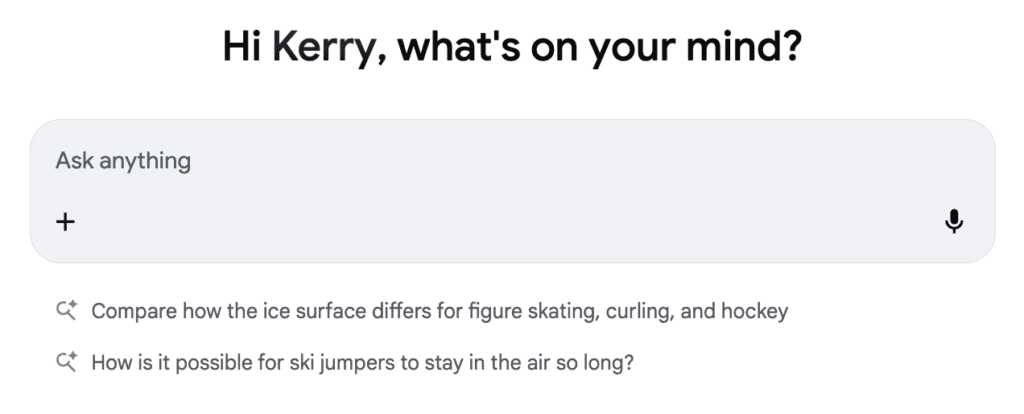
Unlike a standard search bar query that spits out a list of links, AI Mode is multimodal. This means the AI model (specifically Gemini) can understand and process text, images, video, and even audio. It’s integrated directly into the Google App and Chrome browser, offering a conversational interface similar to ChatGPT, but with the vast, real-time index of Google behind it.
Key Differences
In traditional search, a user types “best CRM for B2Bs.” Google looks for those keywords and ranks pages that contain them. The user then has to click, read, and synthesize the info themselves.In AI Search, the user might ask, “I need a CRM for my small B2B that integrates with Mailchimp and costs less than $100/month. What are my options?”
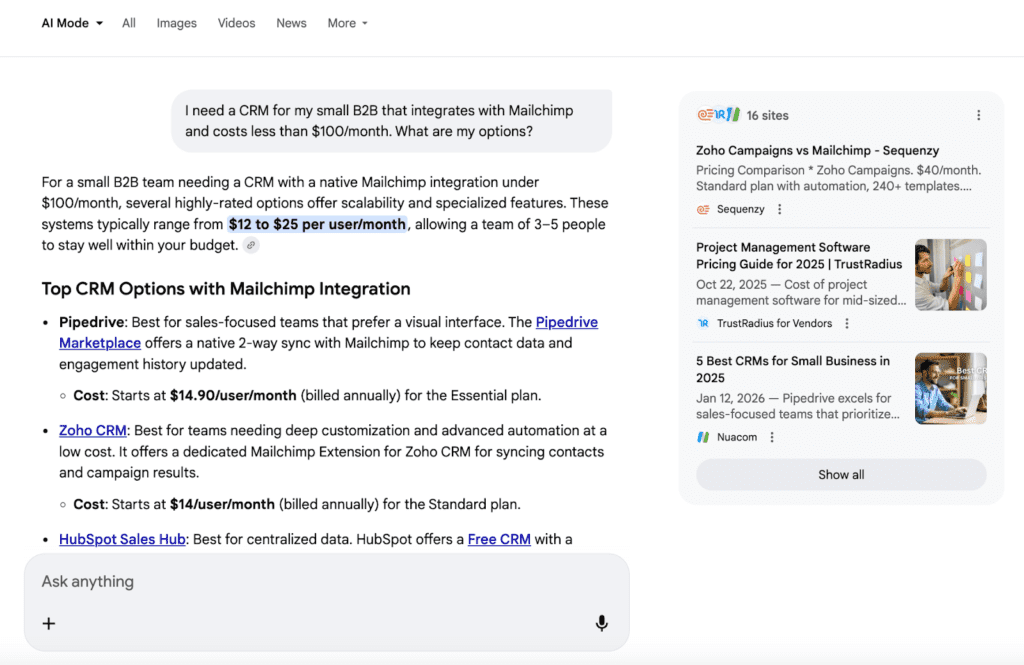
The generative AI does the heavy lifting. It reads the reviews, checks the pricing pages, looks at integration documentation, and presents a summarized answer with citations. It supports follow-up questions by remembering the conversation’s context (thanks to past searches and personal context).
Key AI Features
- Deep Search: For Google AI Premium or Ultra subscribers, the AI can go even deeper for new searches, performing complex reasoning and multi-step research.
- Workspace Integration: It can pull data from Gmail and Drive to personalize results (e.g., “Find the flight details from my email and suggest hotels near the conference center”).
- Google Photos: It can even answer questions about your own visual library.

Why Impact-Driven B2B Organizations Can’t Ignore This
You might be thinking, “Does this really apply to us?”
Absolutely. In fact, it applies more to you because B2B buyers rarely make impulse purchases. They research complex problems. B2B buyers might search for “best CRM for B2Bs with pricing constraints” or “sustainable supply chain partners in the Midwest.”
Previously, they would have had to visit three or four websites to piece together that answer. Now, Google AI does the heavy lifting of synthesis (or at least it’s getting better at it).
If your content doesn’t clearly answer the specific question for the AI to understand, the AI model won’t recommend you.
Immediate Actions: Adapting Your Strategy for AI Responses
Don’t panic. While the technology is new, the principles of good communication remain the same. Here is how we pivot your strategy to ensure you stay visible, relevant, and growing.
1. Answer Questions with High-Quality Authority
The AI needs fuel, and that fuel is high-quality information. Fluff doesn’t cut it anymore.
Action: Audit your content. Does it directly answer the “who, what, when, where, and why” of your industry?
SEO Tip: Focus on depth and utility. Don’t bury your value proposition under five paragraphs of intro text. Be the direct answer. If the AI judges your content as thin, it will bypass you in favor of a source that offers more substance.
2. Optimize for Conversation (Not Just Keywords)
People are no longer typing “B2B marketing agency.” They’re typing—or speaking—natural, conversational sentences.
Action: Target natural language queries. Think about the specific questions your clients ask you on the phone or in emails.
Strategy: Write content that mirrors that dialogue. Use Q&A formats. If you are writing about e-commerce for museums, phrase your headings as questions: “How can museums increase online gift shop sales?” rather than just “museum e-commerce strategies.”
3. Structured Data is Your Best Friend
You need to help the AI understand your content. This is where the technical side of SEO becomes critical.
Action: Use schema markup (structured data) on your website.
Why: Google AI Mode relies on structured data to quickly parse information about events, people, products, and pricing. If your data is structured, it’s easier for Gemini to read it and serve it up in a rich result.
4. Double Down on E-E-A-T
In an era of AI-generated noise, human expertise is the premium currency. Google places massive value on E-E-A-T (Experience, Expertise, Authoritativeness, and Trustworthiness).
Action: Demonstrate your credentials. Show your authors’ bios. Cite your sources. Highlight your mission-driven status. If a user asks a medical or financial question, Google’s AI model is trained to prioritize sources with proven trust.
5. A Holistic SEO Approach
You can’t just do on-page SEO. You need technical health (fast load times), functionality, and off-page authority (backlinks).
Action: Ensure your technical foundation enables Google Search crawlers to easily access your data. If your website is slow or broken, the AI will skip you. It needs real-time access to fast, clean data.
6. Monitor and Analyze
The landscape changes weekly. What works today might change when Google announces the next algorithm update.
Action: Keep an eye on the newest trends and opt-in features. Watch your analytics for shifts in traffic patterns. Are people asking follow-up questions that lead them to specific deep-dive pages? Adapt accordingly.
Looking Ahead: Long-Term B2B Success
Your goal is to build a brand that people search for by name. If the AI knows you’re the authority, it will cite you. If users know you’re the authority, they’ll skip the search engine entirely and come straight to you.
You can use tools like ChatGPT or Gemini to help draft content, but always have a human expert review it. Don’t rely solely on AI tools to write your thought leadership—it often lacks the nuance and personal context that connects with human readers.
Finally, build your own audience. Grow your email lists and nurture your communities so you aren’t 100% dependent on Google search results.
Ready to future-proof your digital presence? Partner with Big Sea to build a strategy for your B2B organization that keeps you visible, relevant, and growing.

FAQs about Google Search AI Mode
How Does AI Mode Impact SEO?
AI Mode shifts the focus from simple keywords to user intent and conversational queries. It prioritizes content that provides direct, comprehensive answers. While it may reduce clicks for simple questions (zero-click searches), it can drive higher-quality traffic to pages that offer deep, expert insights.
What Is the Difference Between AI Mode and AI Overviews?
AI Overviews (formerly SGE) are the specific summaries you see at the top of the results page. Google Search AI Mode refers to the broader, integrated experience powered by Gemini that includes these overviews, multimodal search (images/video), and conversational capabilities within the Google App and Google Chrome.
Can AI Mode in Google Search Improve My Search Results?
Yes, if you adapt. By optimizing for E-E-A-T, using structured data, and answering complex questions thoroughly, you can appear in the prime AI snapshot position. This establishes immediate authority and can drive highly qualified traffic to your site.